Austin’s Woodie Chronicles
By Colin Peck (With compliments and permission from The Austin Counties Club - www.psimmonds.org.uk)
While Austin can’t lay claim to building the first or last Woodies in the UK, few people realise that Austin was actually one of the most prolific builders of these wooden wonders this side of the Atlantic. Although I could fill a number of issues of County Counsel with the details of how and why Austin sold Woodies, here’s the short version.
By way of background, the term ‘shooting brake’, which most of us associate with Woodies was first coined in the 1920s to describe the wooden-framed bodies fitted to up-market chassis such as Rolls-Royce and Daimler. Indeed they were the original sports utility vehicles long before the term SUV had been invented
Such vehicles were used by the landed gentry for the conveyance of other wealthy toffs and chums so that they could go hunting in the style to which they were accustomed. In fact many surviving 1920s shooting brakes are still fitted with gun racks, cocktail cabinets and firing ports in the sides so that wealthy occupants could stay warm and dry while blasting away at whatever moved without even spilling their gin and tonics.
By the 1930s, Woodies were serving more of a general purpose role at country estates and the term ‘estate car’ was born. Collecting groceries from the village store, taking the children off to boarding school or collecting weekend guests from the local railway station were tasks often assigned to such vehicles.
As the role of the Woodie continued to diversify, the term ‘utility vehicle’ came into usage and a number of coachbuilders offered utilities on a wide range of chassis. Ford, via its Canadian factory, was one of the first to bring the utility car to the masses and by the mid-30s these big V8-powered Woodies were a common sight on British roads, despite being classified as commercial vehicles with a top speed theoretically limited to 30 mph!
During WWII a number private cars were converted to Woodies and reclassified as commercial vehicles to gain their owners a better ration of petrol. In addition a large number of cars were commandeered by the MOD for war duties and many were re-bodied as ambulances, NAAFI wagons and trucks during that time. At the cessation of hostilities many were subsequently converted into Woodies using the services of the UK’s many hundreds of local coachbuilders.
After WWII a number of factors, including shortage of metals – hence a shortage of complete vehicles; a long waiting list for private cars compared to the relative plentiful supply of commercial chassis, and the introduction of purchase tax on cars - but not on commercials (and hence Woodies) – contributed to make the shooting brake, estate car, utility vehicle or call it what you will, one of the easiest methods of acquitting a new vehicle.
Lea-Francis was one of the first auto makers to see a market opportunity and by 1946 were delivering ‘vehicles’ which were not much more than chassis, wings and a bonnet to a local coachbuilders to turn into utility brakes. Alvis quickly followed suit and soon its dealers were offering shooting brake bodies on the TA14 chassis, however these were all small scale operations compared with what Austin was about to embark upon.
Despite not previously having offered a full-scale production shooting brake, Austin was keen to enter the market. It was a great way to help reach the Government quota of new vehicles to be exported, and Woodies required much less steel to build.
|
|
|
Papworth Industries probably had the only full-scale Woodie production line in the UK. The 16 assembly line seen here built 500 Woodies between 1947 and 1949. |
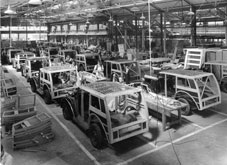
So along came Frank Jordon, who was head of the carpentry workshops at Papworth Industries, the factory business set up by Papworth Hospital in Cambridgeshire which was designed to put the UK’s TB sufferers to some useful work to help with their convalescence. Frank was the former head coachbuilder at the London General Omnibus Company and he heard that Austin was looking for a company to build shooting brake bodies on the Austin 16 chassis. In short, Frank went to Longbridge, knocked on the right door and walked away with an order for 250 Woodies.
The fact that Papworth Industries built the 250 Woodies faster and to a higher than anticipated quality, so impressed the bean counters at Longbridge that they ordered 250 more. These 500 BW1s set Austin on a Woodie-building programme that was to last until 1954, while Papworth then diversified into coaches and trucks and built the legendary ‘Green Goddess’ fire engines for the military. The basis of the company is still in existence today, albeit at a new factory and now known as AssettCo Papworth.
|
|
|
Papworth Industries used the administrative block at Papworth Hospital as the backdrop for most of its official photos. Unlike the hospital or the factory, this facade still stands today! |
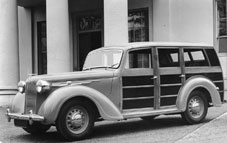
It seems likely that the Countryman name was born with the Austin16 Woodie, as while an early brochure exists describing these vehicles as ‘shooting brakes’ I have also seen another copy of the same brochure which reads Countryman!
Sadly the survival rate for any vehicle with an external wooden frame is extremely low and the 16 Countryman is no exception. The fact that all Woodies are high maintenance vehicles with an inherent requirement to re-varnish the woodwork every couple of years, meant that the onslaught of damp, rot and woodworm could reduce a Woodie to firewood within relatively few years.
|
|
|
This Austin 16 Countryman was prepared for use in Uganda but highlighted how unsuitable wooden bodies were for harsh conditions or tropical environments. It was back at Papworth within two years for major repairs after the body started to fall apart. |
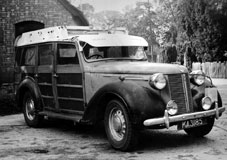
Roof fabrics dry out and split, while joints decompose allowing doors and tailgates to literally fall off. Some years back I went to visit a 16 Countryman that was for sale after being stored in a lockup garage in the East Midlands for more than 15 years. It was a complete wreck with most of the back of the car rotted away and some pieces of chipboard, which the seller inferred was original (yeah, right), stopping the rear of the roof collapsing.
Not too far away is Pete Best’s lovingly restored 16 Woodie, which has been featured in the County Counsel before, and the only other Papworth-bodied 16 that I ever expected to find in the UK. So I was delighted to hear of the ‘new’ 16 Woodie which surfaced at Holkham Hall, in North Norfolk in late summer 2005. This car had been delivered new to the estate in 1947 and was used to take the current Earl of Leicester to school when he was a child. At some stage the Austin was put into a barn for storage and then overlooked for years and years.
|
|
|
This 16 Countryman was delivered new to the estate of Holkham Hall in North Norfolk and was unearthed there recently in a barn. It's currently on display in Holhkam's Bygones Collection. |
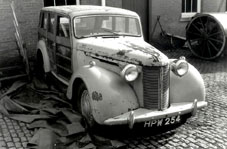
Holkham Hall is now home to the Bygones Collection of vehicles and chief engineer in charge of the vehicles, Brian Ayton, told me that the Earl asked him to look in the old barn to see if there were any vehicles in there that could be added to the collection and Brian was amazed to find the 16 Woodie.
The barn was in poor condition and unfortunately the 16 had been exposed to the elements and so this ‘barn find’ Woodie has all the typical problems of roof fabric and rear end decay – in fact a good portion of the rear end has literally collapsed and the car may be beyond economic restoration.
My contacts at Papworth and its former employees are continuing to unearth new information on Austin’s wooden wonders so look out for the next thrilling instalment coming to a County Counsel near you soon!