|
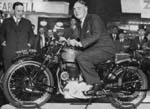
Car's and Traffic The rise of motorization may be accepted as a simple fact, but the question why in particular the Austin Seven was so successful and who exactly could afford this vehicle still arises. In the early twenties there were only around 200 000 privately owned vehicles in Great Britain. However, this number surpassed the 1 000 000 threshold by 1930 and by 1939 more than 2 000 000 Britons drove their own vehicles. Before the First World War a motorized vehicle was merely regarded as a toy to amuse the rich upper crust. However, changing economic demands soon compelled the local industry to free itself from the burden of these costly and unreliable extravagant single units, which resulted in the sudden influx of large scale produced vehicles from the USA. Austin and Morris were the first to embrace this challenge and hence became the initiators of small vehicle mass production. The market situation, back then, of just under £ 200 per unit made it possible for the middle class to own vehicles too. Strong domestic competition gave rise to mass mobilization and the consequent traffic dilemma of the thirties.
Apart from individual traffic there were also public modes of transport, which mainly consisted of trams and busses. Now that it was easier to facilitate free time the first leisure bus trip organizations became trendy.
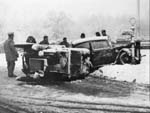
However, a new predicament cropped up: a rapidly increasing number of fast cars traversing typically English country roads propelled traffic accidents to top of the list outlining leading causes of deaths. It was not long before conflict broke out between motorists and rural residents, which saw bottles being shattered on the streets and adults encouraging children to throw stones at passing vehicles. The official speed limit of twenty miles per hour, which was valid until 1930, was barely adhered to from the outset and the measures enforced back then, namely radar traps and ambitious traffic officials, continue to pursue motorists to date. In the cities the situation was even worse, with as many as 7 000 fatalities and 100 000 injuries occurring in 1934. These numbers reoccurred in the sixties, although there were half a dozen additional vehicles on the roads at that stage.
The reason for the high numbers of deaths and fatalities in the thirties have been partially given, however confusion was also created by the strong variations in regional speed limits and traffic laws.
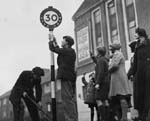
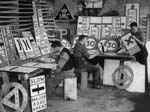
The situation was further aggravated by the fact that the concept of a driver’s license did not yet exist, let alone that of a driving test. Whoever obtained a license to own a car was allowed to drive it on England’s roads from the age of seventeen. However, 1934 proved to be one of the years of profound decisions with the transport minister back then, Leslie Hore-Belisha, introducing the driver’s license, speed limits, traffic circles (roundabouts), pedestrian crossings, yield signs as well as the infamous Belisha-beacons (caution signs with blinking yellow lights). All these measures contributed to the effectiveness of traffic management. There were now mayor-road-ahead signs, one-way signs, speed limits of thirty miles per hour signs in all built up areas and most importantly, all new drivers were now subjected to a driving test.
|
|