The
Twenties
and The
Thirties
- The
Decade
- Fashion
|
 |
Men's wear
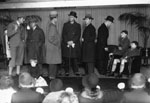
After World War I the German men's fashion orientated on
an
"international
clothing style".
This asked for a
lounge suit with
high waist and a
flap that barely
covered the
buttocks. It had
wide lapels,
only two buttons
at the front and
pockets with
flaps. The
trousers that
tapered were
named
"cork-screw
trousers".
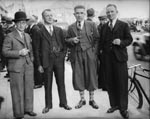
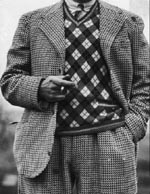
In the middle of the 20's the shape of the lounge suits
changed. It was
less waisted,
the waistcoat
was visible
under the jacket
and the trousers
were equally
wide. Moreover,
the supply of
patterned
material
(checks, dots,
stripes, points
...) grew.
Popular colours
were grey, blue
and brown. But
very modern and
eccentric
fashion
("Dandy's
fashion") was
only worn by the
youth,
individualists
and
intellectuals.
They liked
especially the
very wide
"tango-trousers"
that came from
England. There
they were called
"Oxford bags"
because students
wore them over
their shorts
after sports to
avoid the cold.
Cut-away, dinner
jacket and
tail-coat were
popular
dress-suits. The
dinner-jacket
was the most
modified. Its
cut corresponded
to the lounge
suit.
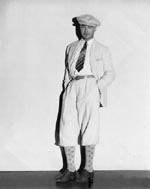
Sportswear
consisted of
very wide
knickers and a
sports jacket
with stitched
seams, patched
pockets and a
belt.
Before the
world-wide
economic crisis
of 1929 a
noticeable
change came into
men's fashion
that lasted with
only a few
variations into
the 30's. The
upper part of
the body was
more accented
with wide
shoulder pads,
while the suit
was less waisted
but with a flap
clinging to the
hips. The lounge
jacket was long
and had a very
wide lapel. Men
mostly wore a
single-breasted
lounge suit with
three buttons
(but only the
button in the
middle was
closed). The
double-breasted
suit was only
worn at official
occasions by
day. A
white
handkerchief had
always to be in
the breast
pocket. The
trousers were
wide and equally
cut with cuffs.
Fashionable
colours were
blue, iron-grey
and havanna.
Originating from
evening suits
the dinner
jacket conformed
to the style of
lounge suits.
The waist-coat
was substituted
by a sash little
by little. The
tail-coat got
fashionably wide
trousers.
The sportswear
from the 20's
lasted into the
30's with only
few variations.
But it came into
fashion to wear
the sports suits
by day in the
city. That was
why tailors
"protested"
against the bad
habit to wear
knickers and
leather trousers
at every turn. |
|
Lady's fashion
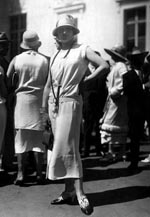
At the beginning of the 20's the everyday dress was cut
wide and loose.
The low waist
was draped with
scarves, bows
and fashionable
belts as
eye-catchers.
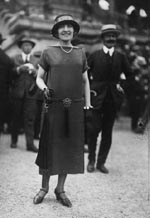
In 1924 that
style came into
fashion which
stayed for 4
years and is
well-known as
the "Charleston
look" up to this
day. The tight
cut dresses
reached barely
to the knees,
the upper part
was straight and
the pleated
skirt on one
level with the
hips. Many of
them were high
closed and had a
straight shirt
collar. Ties,
jabots, colorful
blends, bows and
belts enlivened
the dresses. The
difference was
more in the
detail than in
the cut.
Evening dresses
corresponded in
their straight
line to the
everyday
clothing.
Different were
the neck-lines
that often had
the same size at
the front and
back. Thus many
dresses were
held from small
straps only.
Expensive
fabrics and
eccentric
trimmings made
up for the
simple cut. From
the middle of
the 20's on even
the legs were
shown.
Nevertheless the
hem was soon
longer again
(since 1927).
Especially
fashionable was
a skirt with a
short front and
a longer
backside. At the
same time the
waist drew
nearer to its
natural place.
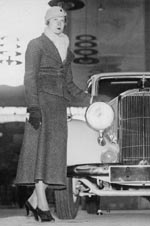
At the end of
the 20's the
fashion lead to
a new, very
feminine line. A
dress that
accented the
shape and
reached to the
calves dominated
the fashion of
the 30's. The
dresses were
clinging around
the hips and
wide-flared near
the hem. From
1933/34 on some
modification was
visible. The
silhouette of
the upper part
was more
accented,
especially the
shoulders with
the help of
puffed sleeves,
ruffles, pleats
or short
boleros. An
asymmetrical
draping of the
top passed for
very stylish.
1938 came a new,
more severe line
into fashion.
The shoulders
were extremely
accented and
grotesquely
widened.
Simultaneously
the skirt,
mostly a pleated
or a wide-flared
one, reached to
the knees only.
Patterns of
pepita, stripes,
points and
pastel shades
dominated.
The rationing of
materials and
the compulsion
to dress
practically and
simply stopped
every
fashionable
development
during World War
II. The pre-war
fashion with
wide, male
shoulders and
short skirts
varied scarcely.
The mottos "save
material" and
"mending is
better than
ending" in
lady's journals
propagated
combinations of
different
fabrics (rests)
and reparations
of torn parts.
Trimmings and
decorations were
economized.
1947 Christian
Dior put a new
lady's fashion
on the market.
His "New Look"
dominated up to
the 50's. The
dresses, with
natural
shoulders again,
were
wide-flared,
waisted and
reached to the
calves.
|
|
Back
to top
Back
to The Decades Page
Back
to Info and Facts Page |